Saturday, 31 August 2013

Birding in the Masai Mara and on Lake Naivasha, Kenya July 2013

I have just returned from another school trip to Kenya and the birding was once again limited but incredibly rewarding. Two of my favourite places in the world, the Masai Mara Game Reserve and Lake Naivasha, both produced some outstanding birding, lots of photo opportunities, and some of the most incredible wildlife moments I have ever experienced, including an up close and personal time with thousands of Black Wildebeest crossing the Mara River as part of their annual "Great Migration". So this post will have a bit of everything - stunning birds, life and death situations, and an array of photos that I hope do justice to both the subjects and the moment!

We stayed in the Mara for three nights at Mara Intrepids. I commend this outstanding lodge to any who may be thinking of heading to Kenya and the Mara. It is a tranquil, delightful place and the service is outstanding. You can check it out at http://www.heritage-eastafrica.com/tented-camps/mara-intrepids/. It is also one of the best places in Kenya to see Schalow's Turaco - one of my favourite birds (oh, and Leopard!).

This year I just have to start with the mammals and reptiles! Our first "game drive" was in the evening and was simply awesome - we came across one leopard on a "kill", and then another hunting impala. We also found a hyaena den and the cubs were almost cute!


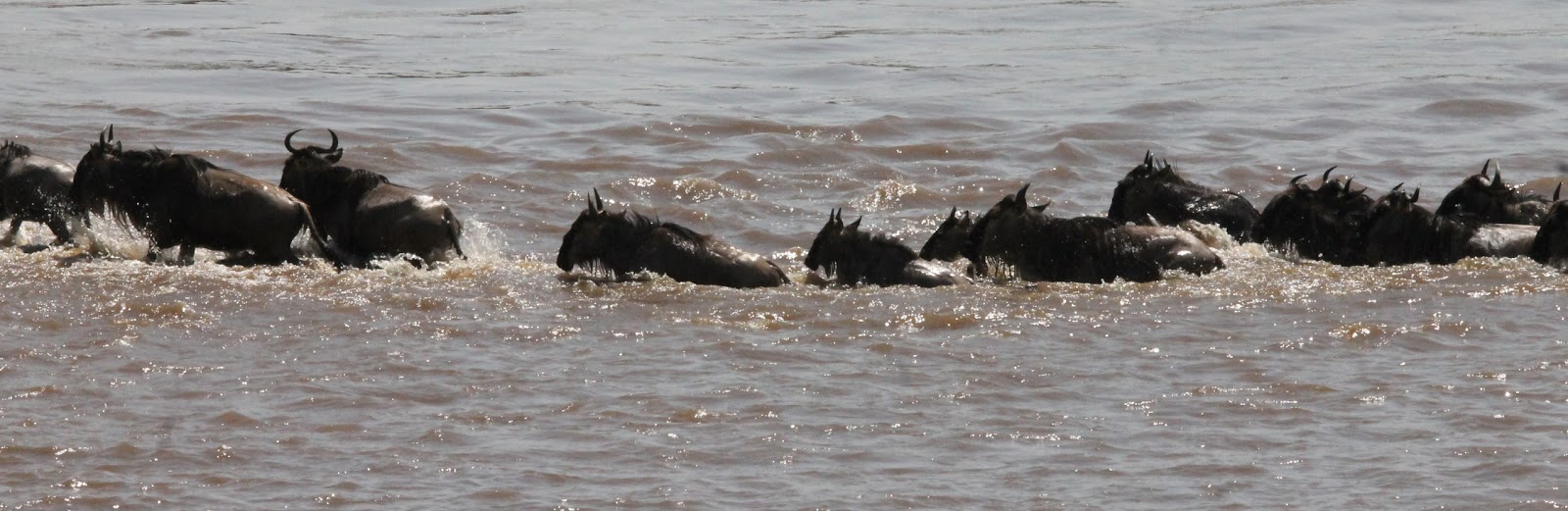
However, the next day was quite simply one of the best wildlife experiences I have ever had. We found a cheetah on a fresh "kill" (a poor little baby wildebeest), and then drove through large herds of both black wildebeest and common zebra - many of whom had recently crossed the Mara River from Tanzania into Kenya. The possibility of seeing this "great migration" in action on the river electrified the entire group.


We drove down to where the wildebeest were "massing" - an extra-ordinary sight as hundreds of thousands of these funny looking ungulates bunched around the edges of the steep slopes of the river, waiting for one brave soul to lead the way. Huge Nile crocodiles were positioning themselves for an opportunity to launch an attack once the crossing began. The air of heightening expectation was palpable, and so we waited.......... until after about an hour of indecision, suddenly .........
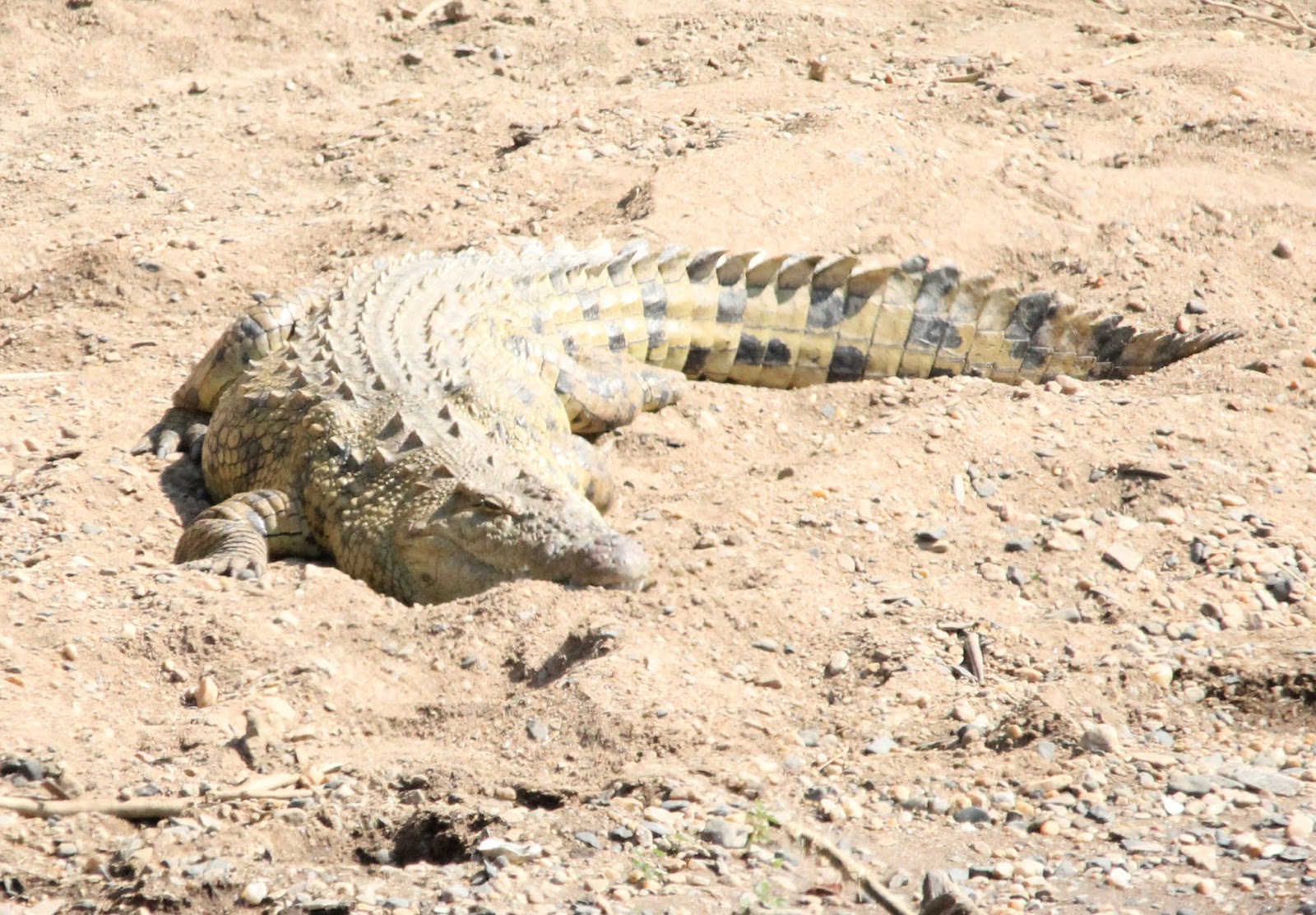

............... they went! Thousands of animals began pouring down the banks of the Mara. Wildebeest launched themselves into the water and made a dash for the bank on the other side. Crocodiles swept in. Some of our team witnessed the water erupting in front of them, as one enormous crocodile surfaced with half a wildebeest lodged between its jaws! We sat spellbound for what seemed an age until it was time to go. We reluctantly moved away while this most stunning spectacle continued on as more and more wildebeest were driven down the bank by an ancient compulsion to reach the lush new grass on the other side.



On the way back to Intrepids, we saw many different mammal species, including cape buffalo, impala, Thomson's and Grant's gazelle, eland, olive baboon, Masai giraffe, warthog, Kirk's dikdik and elephant. There is nothing quite like the wildlife of the Mara - it truly is the "greatest show on earth".  


The next morning dawned with a sense of resignation. How could anything match the events of the day before! Well, were we in for a treat! The first thing we came across was a pride of nine lion attempting to hunt. Initally they unsuccessfully stalked a couple of buffalo, but then turned their attention to a small pod of hippo, allowing for some awesome photo opportunities. After about a half an hour, both parties called it an honourable draw and the lions moved on.


Later that afternoon, a couple of us visited the Musiara Marsh in the western part of the Reserve to do some birding, and came across a hyaena carrying the leg of a zebra in its mouth. There is nothing like the wild!


So, what about the birds?! Well, as usual, they were amazing! White-browed Robin Chats woke us each morning (along with the occasional grunt of a lion somewhere in the distance), and then we were greeted by Grey-headed Bush Shrike, Black-headed Oriole, Tropical and Slate-coloured Boubou, Superb and Ruppell's Starlings, Schalow's Turaco, Common Bulbul and Common Wattle-eye. The plains yielded Crowned, Blacksmith and Spur-winged Plovers, Fischer's Sparrow-lark, Three-banded Plover, White-bellied, Kori and Black-belied Bustards, Ground Hornbill, Helmeted Guineafowl, Black and White-headed Roughwing Swallows, Angola and Wire-tailed Swallows, African Rock and Sand Martins, White-browed Coucal, Sooty and Anteater Chat, Masai Ostrich, Bateleur and Martial Eagles, White-backed and Nubian Vultures, Ring-necked, Red-eyed and Emerald Spotted Doves, Grey Crowned Crane and Red-necked Spurfowl.

A couple of hours at the Musiara Marsh produced some of my favourites including Lilac-breasted Roller, Cinnamon-chested Bee-eater, African Fish Eagle, Pygmy Kingfisher, Saddle-billed Stork, Wattled Plover, and a fantastic view of the very rare Rufous-bellied Heron out in the open. Birding in the Mara is always incredibly rewarding - with riverine habitats and swamp systems interspersed amongst the rolling savanna grasslands. No lifers, but a brilliant time none-the-less.


Grey-headed Bush Shrike


Black-bellied Bustard


Nubian Vulture


White-browed Robin Chat


Red-necked Spurfowl


Crowned Plover


Three-banded Plover


Wattled Plover


Lilac-breasted Roller


Ring-necked Dove


Crowned Crane

The second part of our trip that involved serious birding was an afternoon spent at Lake Naivasha, located in the Great Rift Valley some 100kms west of Nairobi. Lake Naivasha is a fresh water lake, unlike many of the soda lakes spread along the floor of the Valley. It is a haven for both birds and mammals. A quiet walk through the gardens of the Lake Naivasha Country Club yielded its normal abundant array of bird-life, including African Hoopoe, Grey-backed Fiscal, White-browed Robin Chat, Cape Robin Chat, Common Drongo, Dusky Flycatcher, African Paradise Flycatcher, Grey-capped Warbler, Superb Starling and many others.

However, the best way to see birds at Lake Naivasha is to go on a boat ride. All up we saw seven different species of Heron (Black, Black-headed, Grey, Purple, Squacco, Goliath and Black-crowned), African Jacana, Yellow-billed Stork, Egrets (Great, Yellow-billed, Cattle and Little), White-breasted and Long-tailed Cormorant, Kingfishers (Giant, Pied and Malachite), Grey-headed Gull, Whiskered Tern, Great White Pelican, Hadada and Sacred Ibis, Red-knobbed Coot, Yellow-billed Duck and Hottentot Teal, Little Grebe, and the icon of the lake, the African Fish Eagle.


African Hoopoe


Grey-headed Heron


Black-crowned Night Heron


Cape Robin Chat


Squacco Heron


African Jacana


Great White Egret


Yellow-billed Stork


Purple Heron


Goliath Heron


African Fish Eagle!

And we saw some hippos up close and personal!


If you have never been to Kenya, put it on your bucket list. It is absolutely stunning! Oh, and I saw this beautiful Bronze Sunbird in Nairobi! Enjoy!


Monday, 29 April 2013

Back in the Saddle Again - A Trek to the Mallee

After a hiatus of almost six months, I was able to find three days to "disappear" into the dry mallee region of South Australia, home to some of the most beautiful birds in the country. This area is very much my "home ground" and I love the reddish-brown soil, the tough mallee trees, and the distinct probability that there would be very few other people around! Ah serenity! I was also very keen to give my newish lens (Sigma 150 - 500mm) a thorough work-out in mallee conditions and see what I could produce.

I took off early on Anzac Day, Thursday, 25th April on what promised to be a glorious mid-Autumn day (25 degrees), aiming for Brookfield Conservation Park for an extended morning session. My first expectation was fulfilled - I didn't see another person for the entire four hours I was there. And the birding was great and an excellent appertiser for my main destination, Gluepot Reserve. Australian Ringnecks, Galahs and the ever-present Willy Wagtail greeted me as soon as I emerged from the car at my first stop, a kilometre inside the Park just past the fenced enclosure. The section to the west of the track always delivers and this was no exception. Southern Whitefaces soon appeared, along with Red-capped Robins, White-winged Choughs, Brown Treecreepers, Chestnut-crowned Babblers, two Southern Scrub-Robins, a Gilbert's Whistler, Grey Fantails, Weebills, a Grey Shrike-Thrush, Singing and Spiny-cheeked Honeyeaters (these were everywhere, dominating the morning sounds) and Mulga Parrots. A Magnificent Wedge-tailed Eagle drifted majestically overhead, silhouetted against a cloudless blue morning sky.

 
Red-capped Robin

 
Southern Whiteface

I eventually climbed back into the car with twenty-one species accounted for, and a couple of pleasing photos taken. A good start! I then headed past the dam and on to my second favourite section, the mallee stretching along the northern section of the road once you have climbed the small rise in the landscape. It was much quiter here, but I was still able to spot three more species of Honeyeater (Yellow-plumed, Brown-headed and White-fronted), along with a male Hooded Robin, Striated Pardalote and finally a Brown Goshawk casually cruising by.

I said goodbye to Brookfield and headed on to Waikerie, a pleasant regional town on the banks of the Murray River. The prime birding spot here is Hart Lagoon and I picked up 27 species in under an hour, the highlights being a flock of Red-necked Avocets, over 80 Straw-necked Ibis, Red-kneed and Black-fronted Dotterels, small numbers of Adelaide (Crimson) Rosellas and hundreds (and I mean hundreds of Little Corellas sleeping in the trees lining the river banks.


Red-necked Avocet

And then it was on to Gluepot Reserve. I had heard that Regent Parrots, Major Mitchell Cockatoos and a Collared Sparrowhawk had been sighted recently and these were my three main targets, along with seeing and photographing as many of the great mallee birds as possible.

Apart from having to navigate the opening and closing of four gates solo, the drive to Gluepot, some 62 kilometres north of Waikerie, was uneventful. The bush was very quiet, so apart from one quick stop where I picked up Varied Sittella and Jacky Winter, I went straight to Gluepot Homestead, signed in and then headed for Babbler Campsite. Once the swag was set up, I organised a quiet dinner of steak, potato slices, onion, fresh carrot and lettuce, washed down with an icy cold Bundy's ginger beer. White-browed Babblers, Chestnut-rumped Thornbills and Weebills moved amongst the bush as I settled back in my chair and watched the sun go down. Pleasant indeed!

 
Jacky Winter
 
 
Weebill

 
Chestnut-rumped Thornbill

I awoke early the next morning and took a photo of the full moon just before sunrise. Friday promised nothing but glorious weather (27 degrees), blue skies and plenty of birds (I hoped!).


I headed down track eight to Grasswren Hide (now called Josie's Hideaway), arriving at about 6:45am. I decided to work my way through the bush to the south of the hide, near the large water tank. The bush was alive with birds and I quickly added White-browed and Brown Treecreeper, Willy Wagtail, Red-capped Robin, Crested Bellbird, Grey Shrike-Thrush, Gilbert's Whistler, Australian Ringneck, Hooded Robin, White-fronted and White-eared Honeyeater, Grey Fantail, Red Wattlebird (they look far more impressive in a rural setting!) and Common Bronzewing to the list. By the time I got to the hide it was after 8:30am and rather quiet, so after an uneventful half an hour, I headed back to Babblers for brunch.

 
Hooded Robin

 
Striated Pardalote

 
White-browed Treecreeper
 
 
White-browed Treecreeper
 
The afternoon was very quiet, but I did manage to find a flock of White-winged Chough, a small party of Striated Pardalotes cooling themselves down by spreading their wings out and a lovely group of Varied Sittellas who came in for a close visit.

 
Striated Pardalote

 
Varied Sittella
 
Life was beginning to take on a familiar theme as I headed "home" to Babblers for steak, potato, onions, fresh carrots and lettuce all washed down with a cold Bundy's. How  simple life can be when you are only looking after yourself! I decided to go for a quick "night drive" and was pleased to pick up a Spotted Nightjar sitting in the middle of the road. Nice! I was in my swag by 8:00pm and asleep pretty soon after that.

Saturday morning could have been Groundhog Day - there was the full moon, not a cloud in the sky, and with the promise of another glorious day ahead (27 degrees again!). Instead of driving straight away, I went on the South Babblers walk where the first hundred metres was excellent! White-browed Babbler, Hooded Robin and Crested Bellbird were the highlights. Unfortunately, once I had left the mallee trees and entered the casuarina section, it all went very quiet. So I nipped back to the car and headed for Grasswren Hide again. I stopped off at a reknowned Striated Grasswren site, but they failed to make an appearance, or even make a sound.

Slightly disappointed, I drove on to Grasswren and entered the hide where I met Lindsay, a birder from Victoria who informed me that I had just missed Regent Parrots, Mulga Parrots and Major Mitchell Cockatoos! NOT HAPPY!! Although Lindsay looked suitably crestfallen for me, I could tell that he was secretly "chuffed" that he had "scored" while others hadn't, a not uncommmon trait amongst birders. Nasty people, really. Undeterred, I settled in and hoped fervently that the Parrots might return. Nu! However, three species of Honeyeater did put in an appearance and provided some great photo opportunities, so I cheered up pretty quickly. After about an hour and no sign of any Regents or Major Mitchells, I gave up and went back for brunch. 

 
White-eared Honeyeater

 
Yellow-plumed Honeyeater 

 
Spiny-cheeked Honeyeater

After a good feed, I decided to head to Old Gluepot Hide. Along the way I stopped at a likely looking spot and jagged a beautfiul Gilbert's Whistler. My contented state was almost back to full. I then settled in at the hide and watched a few Spiny-cheeked Honeyeaters think about coming in for a drink. A lovely couple happened to wander by and casually asked,

"Have you seen the Major Mitchell Cockatoos?"

Thinking that they were poor desperate souls like me out searching aimlessly amongst the mallee, I replied, "Unfortunately not!"

"Oh!", they said, "They're just down there in that tree. There are seven of them". I just about knocked them down in my haste to get out of the hide (like I said, we're a nasty breed), but did eventually remember to yell out a belated thanks! I tore down to the tree and there they were. JOY!! Seven absolutely magnificent Cockatoos sat contentedly amongst the branches of the tree and remained almost oblivious of my presence as I frantically took photos. BLISS!! I had only ever seen one before up at Bowra Station, but nothing like this. I spent about half an hour with them and then reluctantly dragged myself away, leaving them to their midday slumber.

 
Gilbert's Whistler


Major Mitchell Cockatoos


The rest of the afternoon was comparatively uneventful and I finally wandered back to base, a very happy birder. One down, two to go, and some great photos of a range of species all locked in. It had been a great day. Steak, potato, onions and fresh carrot (the lettuce had died) and a Bundy's finished off the day as I watched the sun go down. I did another "night drive" and picked up a Tawny Frogmouth sitting happily in a tree by the road, so the day ended exceptionally well. Asleep by 8pm.

I awoke on the final morning (Groundhog Day was now really real!) I left early and headed straight for Grasswren Hide. I was there by 6:45am. No-one else in sight. A small victory! (we can also be rather petty as well!). I settled into the hide with camera at the ready. A few minutes later Lindsay arrived, along with another couple. Pleasantries were exchanged and we waited. A Grey Currawong came for a visit and posed nicely for the cameras and then a Red Wattlebird turned up for a drink. Very nice, I thought, but bring on the good stuff! And then a flock of Australian Ringnecks bustled in and took over the up-turned drum full of water. They were quickly followed by a flock of Mulga Parrots, and it all became rather hectic around the water. We counted 24 Ringnecks and 18 Mulgas and it was quite spectacular. Cameras were clicking madly. This was more like it! But still no Sparrowhawks or Regents.

 
Grey Currawong

 
Red Wattlebird


Australian Ringnecks

 
Mulga Parrot

 
Mulga Parrot

Suddenly, all the birds took off in a mad flutter of wings. We instinctively looked up and saw a raptor whiz past and land in a tree about 30 metres from the hide. We were able to get a good view of it and quickly determined that it was a beautiful Collared Sparrowhawk. Yes! Unable to resist the temptation, I grabbed my camera and carefully and quietly worked my way over to where it had landed. Half-expecting it to fly off, I stopped at various distances from it and took a photo, not knowing whether it would be the closest one I would get. The Sparrowhawk remained unmoved until I was literally standing next to it. What a majestic little raptor with its grey hood, rufous nape and beautifully barred chest and belly. I have seen Sparrowhawks before, but nothing came close to this type of encounter. I spent quite some time with it until I eventually headed back to the hide. Feeling very pleased, I sat down with Lindsay and the others and waited again.

The Ringnecks and Mulgas had returned, and five minutes after getting back, a small flock of Regent Parrots swept in and landed right in front of us! They immediately became my favourite parrot - what a magnificent bird! More followed and we eventually had over a dozen of them not twenty feet from us. My only other sightings of these birds have been from large distances away whilst overlooking the Murray River, so this was extra-special. And then to cap it off, two Major Mitchell Cockatoos literally dropped in to join the party! It was spectacular! We were all enthralled with the array of birds in front of us, displaying, drinking and generally having a brilliant time! The Cockatoos didn't stay long, but the three species of parrots stayed around for ages, as did we! I eventually dragged myself away, realising that I needed to get home!

 
Collared Sparrowhawk


Regent Parrots


Major Mitchell Cockatoos
 
I drove back to Babblers via track seven and was fortunate enough to come across White-browed Woodswallows, Masked Woodswallows and a Southern Scrub-Robin all inhabiting the same dead tree. They all posed happily for me and then it was back in the car and off to camp to pack up and head home.

 
White-browed Woodswallow

 
Masked Woodswallow

 
Southern Scrub-Robin
 
700kms, perfect weather, priceless "alone time" and an amazing array of birds made this trip incredibly special. That I was able to see and get really pleasing photos of my three target species was nothing short of awesome, and I headed home both very content and so appreciative of the incredibly unique and special place that Gluepot is. It had more than met my expectations once again. I will return!

Mike Potter, April 2013.