Monday, 24 September 2012

The Great Birding Adventure 2012 - Part 2: Queensland

I arrived back from WA on Friday evening (10th August) to discover that I had been volunteered to sleep in the school auditorium (on the floor on a mattress) with about two dozen Middle School lads who were having a sleep-over/full day workshop for the Middle School musical. I love my wife! Well, as I was taking off again on the Sunday for four weeks, I felt that any protests in regards to helping out probably wouldn't be recieved with much grace, so I wisely kept my mouth shut and did as I was told.

Sunday quickly came around and I was back on a plane heading for Brisbane with two of my leaders from the school. Phil is a mad keen bird breeder, so he was happy to include some birding in the programme. Mark was neither, but diplomatically accepted that his boss was mad, and smiled patiently whenever I chatted about the possible birds I could see, which was often. We had an over night stay in Brisbane, and then flew to Carins and then on to Normanton, on the south-east corner of the Gulf of Carpentaria to visit a small indigenous school that we were keen to develop a "sister school" arrangement with. We landed just after lunch to a blamy 30 degrees celcius! A mate from the Sunshine Coast, whose school oversees the programme in Normanton, accompanied us and showed us the sights of Normanton. It took ten minutes. We settled into the local caravan park and prepared to spend the afternoon driving to Karumba to check out a boat trip that we would have as part of the "Top End" experience for our students if we went ahead with the "exchange".

We had only just left Normanton when we stopped the car very quickly - Sarus Crane virtually by the road! I was stoked, and even Mark looked somewhat impressed. Lifer Number 1 for the QLD adventure. Not a bad one to start with!! We also saw plenty of Brolgas, White-necked and White-faced Herons, Brown Falcons and Australian Kestrels on the drive to Karumba.

We were met by the locals at Karumba, who loaded us onto a boat, along with a very pleasant American couple, and away we went. The bird life was prolific - Jabiru (Black-necked Stork), Brahminy, Whistling and Black Kites, White-breasted Sea-Eagles, Great-billed Heron (only the second time I had seen them), Little and Great Egrets, Eastern Curlews, Sacred and Azure Kingfishers, and a White-breasted Whistler were the highlights. No extra lifers, but a fantastic late afternoon of birding, along with quite a few very impressive crocodiles. Absolutely recommend you go with the Ferryman cruises. They do specific birding boat trips and seem to know their stuff.


A Big Croc!

The next morning, Phil and I got up early and went for a drive. The local birding was excellent - we saw Blue-faced, Brown, White-naped, and also Yellow Honeyeater (Lifer Number 2!), along with Double-barred Finches, Brown Falcon, Red-winged Parrot, Rainbow Lorikeet, Australian Hobby, Zitting Cisticola, Black-faced and Masked Woodswallows, more Sarus Crane and Brolga, all three Ibis species, Radjah (Burdekin) Shelduck, Cormorants, Darters, Peaceful Doves, and many more in a couple of hours.

We then met up with the others and went over to the school. Gulf Christian College is a fantastic set-up with about 50 students. The staff are dedicated and passionate educators, and the faciltities are excellent. The kids seemed happy and enthusiastic, and we had a great conversation with them that we hope will now lead on to an ongoing relationship between the two schools. Very positive. We were soon back on the plane to Cairns, then on to Brisbane, where we collected out hire car and headed to the Sunshine Coast. A long but very successful day.


The next morning was a "rest" day, so Phil and I headed to the Noosa region - this is one of my favourite birding areas and I was keen to show it off. Again, the bird-life was prolific, and we saw an amazing array of species throughout the Noosa National Park and then at Jabiru Park on the way to Cooroy. Nothing new, for me that is, but lots of great spots for Phil, including a couple of "boobies" at Alexandria Bay. Unfortunately, they were ancient - enough said. We headed back to our hotel, met up with the rest of the team from the school and headed out for dinner with teams from Nambour Christian College and Thomas Hassall Anglican College. A great day, and a great night out. The next day was full of meetings and eating, all of which was incredibly useful, but of not much interest for birders, apart from a Pale-headed Rosella that appeared by the window during one meeting - found it hard to concentrate for a few minutes! Farewells were said that night, and Mike prepared himself for the major part of the trek - heading off for three weeks of non-stop birding. Prepare for Part 3!!


The Great Birding Adventure 2012 - Part 1: South-west Western Australia

Between early August and early September, I had the chance to do some serious birding due to a number of school trips and a three week break. So I decided to make the most of the opportunity and see how many I could see and how many lifers I could notch up. Some very serious planning went into the five week stretch - with target birds identified, places booked, local birders contacted, and a brand new camera lens (100 - 500mm Sigma for my Canon 1100D) purchased. Oh, and lots of hugs and doing things around the house to placate the wife! I have divided up the trip into five parts, the first being my visit to South-west Western Australia (Perth region only), and the next four being the more extensive trek between Brisbane - Cairns - Normanton - Lakefield NP - Iron Range NP - Sunshine Coast.

The final result was well over 300 species of bird, 54 lifers, hundreds of photos and wonderful memories. So here they are on paper (or computer screen!). I hope you enjoy the journey too!

August 6th - Taking the "red-eye" to Perth is not my favourite past-time, but the possibility of pickimg up eleven endemics around the Perth region meant that I was keen to make the most of the day and a half I had available to me prior to a school conference I was attending kicked off. I was met at the airport by Peter Taylor, an excellent bird-guide, who loaded me into his 4x4 and away we went. No mucking about - let's get into the birding! The weather was cool, but clear and the promise of good birding was in the air.

First stop was Victoria Dam, located south of the airport. We parked just past the turn-off to the dam and went for our first walk. We were soon into it, with three endemics showing themselves very readily. Western Thornbill, Swan River Honeyeater and Western Spinebill (now one of my favourite birds) came out to greet us, along with fly-overs from Square-tailed Kites, Red-tailed Black Cockatoos and Red-capped Parrots (a WA endemic I had seen a few years earlier). A great start - three down, eight to go! Peter was brilliant, knew the calls and helped with diagnostic identification.

We then wandered down to the stream that flows out at the base of the dam, and I was stoked to spot a Red-eared Firetail flitting amongst the low scrub near the water. It didn't stay around very long which was a shame, because it is a very pretty little bird. After some searching we also found a White-breasted Robin, which is probably one the duller species of Robin in Australia, but a tick nevertheless! The new lens took some getting used to and the inital photos were fairly average, but I was slowly getting the hang of it. No sign of the Red-winged Fairy-wren, so we headed off to check out some of the other sites. Five down, six to go!

By lunch we had racked up a very good list (including Western Rosella, another WA endemic I had seen previously), but no new lifers, so we (well Pete!) determined that we should head out to the Northam region in search of the Mute Swan (which is now a protected species in WA even though it is feral!), Western Corella, Baudin's and Carnaby's Black Cockatoos, and Western Wattlebird. We arrived in the town of Northam and immiedately found the Mute Swans on the river. Not the most authentic tick in the world, but I reluctantly took it! We also had Laughing Dove (another introduced species found in WA that I had already ticked) nearby, and the overall trip list continued to grow.

Peter then took us out onto the country roads around Northam, checking local homesteads for the Corella, and it wasn't long before we came across a large flock grazing on the ground and also roosting in the nearby trees. And then, as we were travelling, Peter decided to pull over to let a car pass, and we heard a Black Cockatoo call from the tree next to the vehicle. We leapt out to find a small flock of Baudin's Black-Cockatoos sitting about five metres above our heads. JOY!! To finish off, we stopped at a small reserve to search for Western Wattlebird. We heard them pretty quickly, but they proved rather elusive. We ventured into the thick undergrowth and got very close to the calls that we could hear ringing out, but still couldn't get a look at the things. Eventually, we went back to track and, as is often the case with birding, two Wattlebirds decided to come over and visit us and we got great views. Nine out of eleven and I was a very happy chappie. No sign of the Fairy-wren or Carnaby's Black Cockatoo, but Peter gave directions to another site that was a good birding prospect for the next day. So, after a most eventful day, Peter dropped me back at the airport where I picked up a hire car and headed for the conference venue. Peter was invaluable and I highly recommend him to anyone wishing to see the WA endemics. Thanks mate!

The next day dawned - miserable weather! I oscillated in my mind whether to go or not for about five seconds and then jumped into the car and headed to Wungong Dam and Bungendore Park. I had heard mixed reports about these places, with some saying that they were heavily degraded, but I decided to have a go anyway. Glad I did!! I got out of the car at Wungong, following the instructions I had down-loaded from the Net. First bird was a Red-winged Fairy-wren (!!) who obligingly sat on a branch near me and posed for photos. I also had wonderful views of White-breasted Robins and Splendid Fairy-wrens. After about an hour I headed over to Bungendore and the birds came out to play! As did the sun! I had Swan River Honeyeaters, Red-capped Parrots and Western Spinebills flitting above my head, while Western Thornbills, Western Gerygones, Western Yellow Robins, Western Wattlebirds, along with Scarlet Robins, Ringneck Parrots, Common Bronzewings and many other birds filling the bush with colour and sound all around me. Fantastic birding!

I eventualy had to drag myself away as I needed to pick up some of my staff at the airport so I reluctantly climbed back into the car. Ten out of the eleven targets seen, with only Carnaby's eluding me. Ah well, I need to get down to Cheyne's Beach at some stage to see the WA skulkers, and Peter assured me that Carnaby's is certainty down there, so it just means planning another trip!! Part 1 completed and Mike was a happy boy! I had seen three Aussie lifers between January and the end of July, and now I had added ten in a day and a half. On to Queeensland!!


Saturday, 28 July 2012

Birding and Mammal Spotting in the Masai Mara - As good as it gets

I recently travelled to Kenya with the school for a three week mission trip - a report on this will be produced through a different medium. However, while there the team visited the Masai Mara GR for three days and we had an awesome time! The following is therefore not a specifically bird report, but the birding was prolific, from the Common Ostrich to the tiny Grey-backed Warbler (Camaroptera)! The mammals were also stunning, and I hope my photos do them justice! Enjoy!

We arrived at Intrepids Camp (check it out at www.heritage-eastafrica.com/tented-camps/mara-intrepids/), an amazing luxury tented camp overlooking the Talek River in the north-central Mara, after a six hour drive from Nairobi, the capital city of Kenya. The road to the Mara turn-off is excellent (tarmac), and then the road to the Mara is awful! However, it is all part of the safari adventure and must be on anyone's bucket-list!

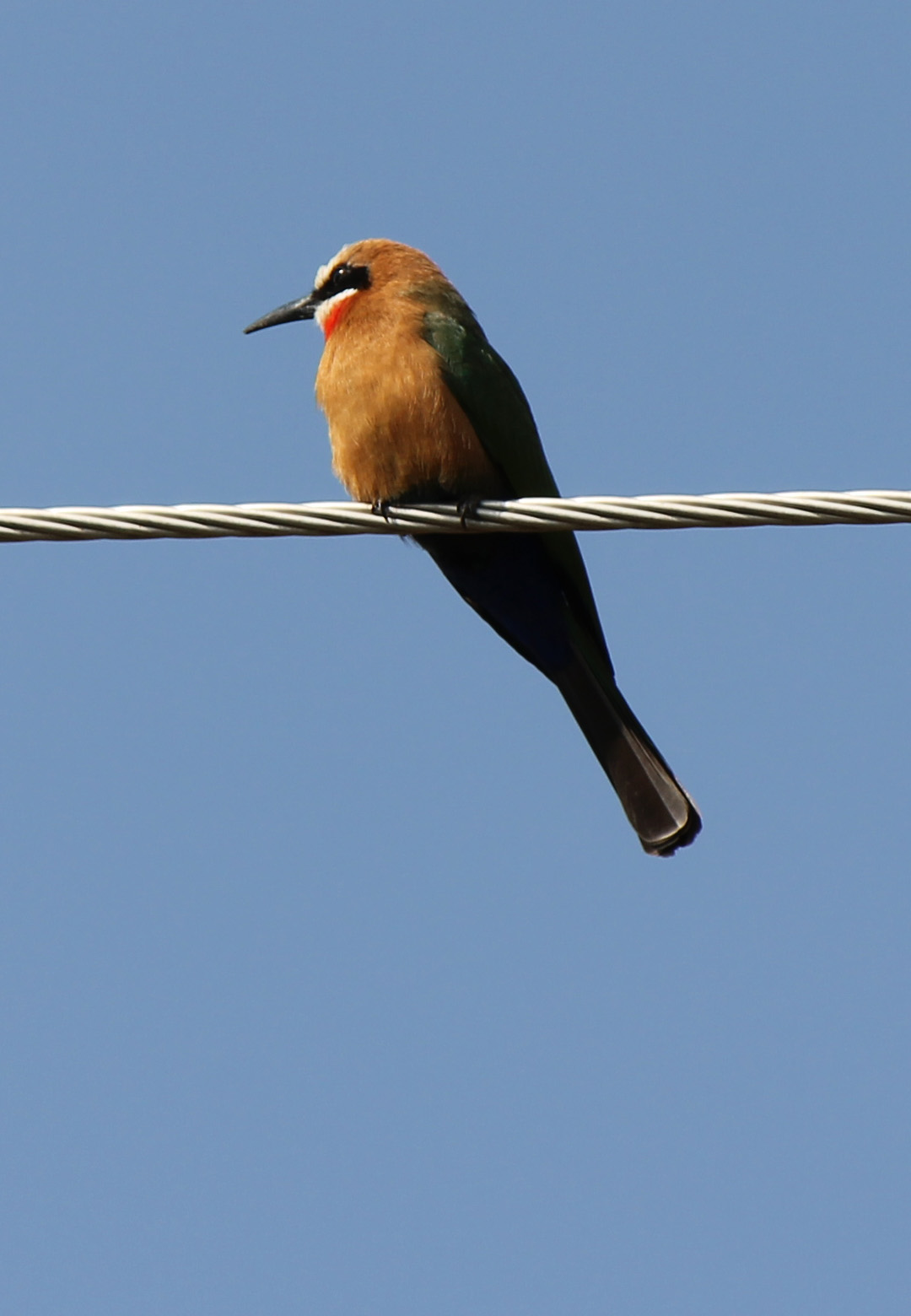
With a group of 38 combined with bumpy, rutted roads, toilets stops were fairly frequent! These were excellent opportunities for Pots to sneak off and do a little birding - I picked up Speke's Weaver, Red-capped Lark, White-fronted Bee-eater, Grassland Pipit (one of the few birds also found in OZ,along with the Common Ostrich of course!), Capped Wheatear and Augur Buzzard.

Once into the camp, it was clear that the birdlife was abundant. I quickly picked up Ruppell's Long-tailed Starling, White-browed Robin-chat, Grey-backed Warbler, Common Bulbul, Schalow's Turcao (one of my favourite birds - see the bottom of my blog page), Tropical Boubou, Slate-coloured Boubou, Egyptian Goose, Black-headed Oriole, and many others. Also scurrying around were Banded Mongoose, Kirk's Dikdik and Vervet Monkeys!


And then we went out for our first "game drive"! The mammals were simply stunning! In the first hour we had seen a mother cheetah with two cubs on a "kill", a cunningly concealed leopard (no photo!), lion, elephant and an array of other mammals - bushbuck, reedbuck, impala, thompson's and grant's gazelle, cape buffalo, and warthog.

Four more "drives" followed over the next two days and we amassed 30 mammal species, over 80 bird species and crippling views of enormous Nile Crocodiles. Along with eating a ridiculous amount of food, lying in bed at night listening to lions, hyaenas and tree hyrax's call out to each other, stumbling on an African Wood Owl hooting on the final morning, and finally picking up a lifer, the Rufous-bellied Heron, along with it's cousins, the Green-backed (Striated), Black-headed and Grey Herons, it was another unforgetable trip in the Reserve.

We also saw courting Common Ostrich - visually compelling dance, Martial Eagle (another favourite), Crowned, Wattled and Spurwing Plover, Yellow-billed Stork, Black-bellied Bustard, Hooded and White-backed Vultures, White-headed and Spot-flanked Barbets, Angolan, Mosque, Wire-tailed and White-headed Sawwing Swallows, African Sand and African Rock Martins, and Yellow-throated and Rosy-throated Long-claws. Plus lots more!! Paradise! If you ever get the chance...... DO IT!


And some of the birds seen on the drives .........


Wednesday, 13 June 2012

A Frenetic Dash North - June 11th 2012

Monday of the long weekend, a new car, and the wife is locked down doing reports and marking. What to do? How about a mad, frenetic dash to Port Augusta's Arid Lands and then Lake Gilles CP? Six target species - WW Fairy-wren, WB Swallow, Chirruping Wedgebill, Zebra Finch, Rufous Treecreeper, And Western Yellow Robin to add to the year list. 900km round trip ...... Very cold weather, no guarantee of success.... Bring it on! Left home at 5:00am, arriving at the Arid Lands just after 8:00am. Temperature ... -1!!

Greeted by a family of WW Fairy-wrens, a very friendly Grassland Pipit and a Grey Butcherbird. Went to the Centre to discover an Australian Kestrel sitting on a light post totally indifferent to my presence. Got to within 20 feet. Awesome! Mulga Parrots, Zebra Finches, three species of Honeyeaters, White-backed Swallows, and a very vocal Chirruping Wedgebill were the highlights of the first part of the trek. 20 species all up.

On to Lake Gilles! Arrived just after 11:00am pulling in to the park on the left near the main campsite adjacent to the road to the lake. A Red-capped Robin flew past as I pulled up. Got out my Morcombe app and played the Rufous Treecreeper call. They came from everywhere! I was dive-bombed!! Settled myself in and soon had them foraging at my feet. At one stage I was concerned that my sneaker was going to be in the same photo as the bird! Wonderful! This seemed such a success that I then played the Western Yellow Robin call. Two beautiful Robins responded, although they were less familiar than the Treecreepers. However they still posed long enough for my best photo yet of this relatively scarce bird for this part of Oz.

A very late lunch in Port Augusta preceded a pleasant drive home, accompanied by my music and then a steadily increasing number of other drivers heading back to the city at the end of the long weekend. A quick stop at Port Wakefield for a Chiko Roll, a Magnum Classic ice-cream and a long pee (I'm getting old!), and then home again just after dark. A great day! Well worth the drive - all six target species seen, the weather was beautiful although rather brisk at first, and the solitude was gold! I love birding!!


Tuesday, 8 May 2012

Magpie Lark dive-bombs unsuspecting Kookaburra

Yesterday, May 7th 2012, it dawned on me that I had never seen a Kookaburra in the northern suburbs of Adelaide, where I have lived for the past twelve years. This morning, three Laughing Kookaburras were sitting on the electricity lines on my street! Ravens, Magpies and Magpie Larks were as surprised as me and were going off! Dive-bombing, putting out alarm calls, and generally making it clear that they were NOT happy! I was able to catch the following on my camera.... cool stuff! Enjoy!